
Insights · Growth Marketing

SEO, AEO, and GEO for 3PLs: How to Attract More Qualified Shippers

SEO, AEO, and GEO for logistics companies helps 3PLs attract better fit buyers by answering real shipper questions with credible expertise.

By Nathan Misirian · October 9, 2026
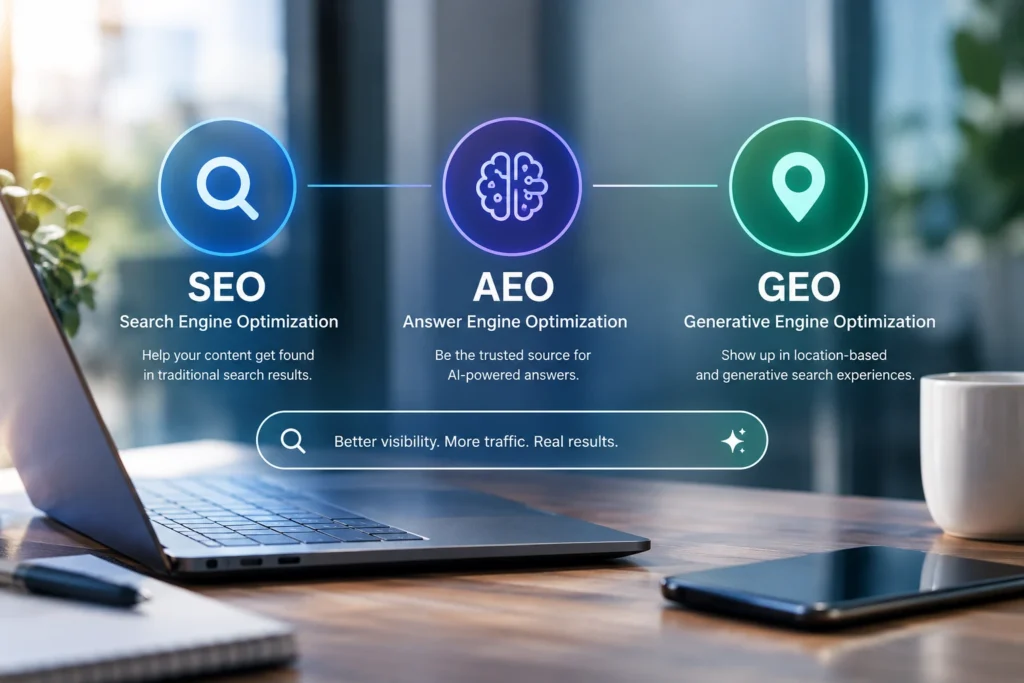
SEO, AEO, and GEO marketing concept digitally displayed over laptop.
Search visibility is only valuable if it puts your company in front of the right shippers.
 
That distinction matters more now because search is no longer just a list of organic results on Google. Buyers are using traditional search, AI generated answers, comparison tools, and paid listings to evaluate providers. At the same time, many logistics websites still describe services in broad, generic language that could apply to almost any warehouse or transportation company. That approach may generate impressions, but it rarely builds trust with serious buyers.
 
Search is changing, but the core challenge is still the same. If your website does not speak to the right shipper, the right problem, and the right operational context, visibility will not turn into pipeline.
 
The goal is not to win every search. It is to become visible when the right shipper is asking the right question, and give them enough evidence to take the next step.
 
In this article, we will explain how those SEO, AEO, and GEO practices fit together, how search intent can help identify better-fit prospects, what serious buyers are really looking for, and how logistics companies can create content that earns trust instead of just clicks.

Shipper Visibility

Visibility matters most when it puts your company in front of the right shipper, at the right moment.

How Can 3PLs Build a Sales Pipeline of Qualified Leads?

Most logistics companies say they want more leads. What they really mean is they want more qualified leads.
 
A form fill is not automatically a sales opportunity. A contact request from a company with five pallets, unclear requirements, and no real purchasing urgency may be valuable to one 3PL and a distraction to another. A larger provider may not even take that call. Another provider may welcome it if they have the appetite to grow with smaller accounts.
 
That is why search strategy has to start with ICP clarity. If a 3PL does not know exactly who it wants to attract, what operational profile fits best, and what kinds of opportunities are too small or too misaligned, its marketing will default to volume over fit.
 
From our perspective as a logistics marketing agency serving 3PLs, the first job of search marketing is not traffic growth. It is alignment between visibility, buyer intent, and pipeline revenue.

How Can Search Intent Can Help Identify Better-Fit Prospects?

One of the clearest shifts in logistics search is that good-fit buyers tend to search differently from poor-fit buyers.
 
Serious, experienced shippers usually search with more precision. They already understand their problem, know the service category they need, and often have enough operational context to evaluate providers quickly. Their searches are more likely to be tied to service type, geography, mode, or complexity.
 
Less qualified or earlier stage searchers often use broad educational language. They may be students, junior staff, or internal researchers who have been asked to explore a topic but are not yet ready to evaluate a provider.

Experienced shipper searches:

Inexperienced shipper searches:

However, this does not mean broad educational content has no value. It can support authority and top of funnel visibility. But if the business goal is qualified pipeline, the content strategy cannot stop there.

How Does SEO, AEO, and GEO Actually Work for Logistics Companies?

Many logistics companies hear these acronyms and assume they are separate marketing channels. However, they’re best understood as overlapping ways of thinking about discoverability, relevance, and usefulness.
 
Here are a few basic definitions to clarify the distinct roles of SEO (Search Engine Optimization), AEO (Answer Engine Optimization), and GEO (Generative Engine Optimization):
Approach
 
 
What it does
 
 
Example use
 
 
SEO
(Search Engine Optimization)
 
Helps your content rank in traditional search results on Google and Bing when shippers search for specific services.
 
 
“warehouse services in Indianapolis,” “ecommerce fulfillment provider,” or “drayage services near the Port of Virginia”
 
 
AEO
(Answer Engine Optimization)
 
Helps your content get pulled into direct answers, including Google featured snippets, People Also Ask results, voice search responses, and AI-generated answer summaries.
 
 
Specific logistics questions from buyers looking for direct answers
 
 
GEO
(Generative Engine Optimization)
 
 
Helps your content appear in AI-driven research and decision-making tools such as ChatGPT, Perplexity, Gemini, and Claude.
 
 
Buyers comparing 3PL options, asking for provider recommendations, or evaluating tradeoffs
 
 
For 3PLs, the practical takeaway is simple: you do not need three different strategies. You need one strategy built around buyer intent, operational expertise, and clear structure.


That means your content should:
 
  1. Target real shipper questions.
  2. Answer them directly and early.
  3. Show specific operational knowledge.
  4. Help buyers compare options and tradeoffs.
  5. Give them a clear next step.


When a page does those things well, it becomes more useful to buyers while also giving search engines and AI systems clearer information to understand, retrieve, and potentially surface.

What Makes 3PL Content More Credible in AI Search?

AI search has changed the standard for what gets surfaced and what gets ignored.
 
Generic copy that simply says you offer warehousing, fulfillment, and transportation services does not do much to differentiate you as a provider. It does not answer a real buyer question, show experience, or give an AI system much reason to cite it.
 
What tends to perform better is content with substance.
 
That includes:
  • direct answers to specific questions
  • original examples from real logistics situations
  • quotes or insights from subject matter experts
  • market specific detail
  • decision frameworks buyers can actually use
  • honest explanations of tradeoffs, constraints, and fit

This is where modern search reinforces a principle that should already be central to B2B marketing: specificity builds credibility.

SEO, AEO, and GEO for 3PLs: How to Attract More Qualified Shippers

If your content sounds like it could have been written for any warehouse in any city, it is unlikely to build trust.
 
For example, content that explains why a shipper choosing a provider in Los Angeles should evaluate regulations, volume expectations, infrastructure realities, contract structure, and local capacity differently than a shipper evaluating Terre Haute, Indiana demonstrates context. That context is useful for both buyers and search systems, giving them more meaningful information to work with.

Attracting qualified shippers?

See what your website should be prioritizing.

Book a Growth Marketing Strategy Meeting and we'll show you how SEO, AEO, and GEO best practices will fill your pipeline.

Why Do Some 3PL Websites Get Traffic but Not Leads?

We see this problem often. A logistics company invests in visibility, starts ranking, and still does not see the right pipeline.
 
Usually the issue is not just traffic volume. It is a mismatch between traffic intent and page value.
 
Here are the most common reasons:

1 – The site attracts broad traffic but does not differentiate for ICP.

If your content is written for everyone, it will appeal to everyone equally poorly. You may attract searchers who are curious, underqualified, or too early in the process.

2 – The page describes services but does not solve a problem.

Many 3PL websites say what they do, but not why a buyer should care now. Buyers are looking for help with cost pressure, capacity problems, retailer compliance, missed service levels, inventory issues, or fulfillment strain. If the page does not speak to those problems, it feels generic.

3 – The content lacks operational proof.

Sophisticated buyers want signs that you understand the work. They are looking for indicators such as SKU complexity, port constraints, order volume swings, storage requirements, reporting expectations, onboarding difficulty, and system integration realities.

4 – There is no decision support.

A buyer comparing providers needs help evaluating tradeoffs. If your page does not provide criteria, comparisons, or next step guidance, the buyer has to do that work elsewhere.

5 – The website does not connect visibility to sales strategy.

Ten qualified leads can be more valuable than fifty weak ones. If the business only measures traffic and form fills, it may think the website is working when sales knows the opposite.

The progression after a click matters: visibility gets someone to the page, relevance keeps the right buyer engaged, credibility builds trust, and useful decision support helps move that buyer toward a conversation.

What Content Types Attract Better-Fit 3PL Prospects?

The best logistics content does not try to sound impressive. It tries to be useful to the right buyer.
 
Content types that tend to attract stronger opportunities include:

Service and location pages built around specific buyer intent

FAQ pages that answer operational buying questions

Comparison pages, such as regional versus national 3PL

Articles framed around mistakes, reasons why, or evaluation criteria

Implementation and onboarding guides

Industry or use case pages tied to real fulfillment or transportation requirements

For example, you don’t just want a page called “Warehousing Services.” A stronger version might answer a question such as what a shipper should look for in a warehousing partner in a specific market, what hidden constraints affect service, and what signs indicate the operation has outgrown its current setup.
 
That kind of content does two things at once. It improves discoverability, and it pre-qualifies the buyer.

3PL Search Readiness Checklist

Is your website attracting the right shippers? Or is it just generating traffic?
 
We created a practical checklist to help 3PL marketing and leadership teams evaluate whether their website is positioned for modern search. 
 
Download the 3PL Search Readiness Checklist below.

Search is Changing. Are You Changing With It?

Search is changing quickly, but trust is still earned the same way. Be specific. Be useful. Show that you understand the operational problem behind the query.
 
The goal is to become visible when the right shipper is asking the right question, and then give them enough evidence to take the next step.
 
That is what qualified buyers respond to. It is also what search engines and AI systems are getting better at rewarding.
 
At Autumn Consulting, we help logistics companies identify opportunities to improve search visibility, buyer relevance, and qualified lead generation. If you want to know whether your website is attracting the right shippers, request a search strategy assessment to identify which SEO, AEO, and GEO opportunities are most likely to attract qualified 3PL buyers, not just more traffic.

Frequently asked questions

What is the difference between SEO, AEO, and GEO for 3PLs?

SEO, AEO, and GEO address different ways buyers find and evaluate a 3PL:


  • SEO (Search Engine Optimization): Helps a 3PL appear in traditional search results for relevant searches, such as “ecommerce fulfillment warehouse” or “cold storage 3PL.”
  • AEO (Answer Engine Optimization): Structures content to provide clear, direct answers to specific questions, making it easier for search engines and answer engines to surface the information.
  • GEO (Generative Engine Optimization): Helps make a 3PL’s content more useful and discoverable in AI-driven search and research, where platforms may summarize information from multiple sources.


In practice, 3PLs do not need three separate content strategies. A buyer-focused approach built around search intent, operational expertise, clear answers, and well-structured content can support SEO, AEO, and GEO together.

Start by defining what a qualified shipper looks like for your operation, including the services, locations, shipment profile, and operational needs you can support. Then create useful pages that address those buyers’ specific searches and explain your capabilities, fit, and next steps.


A 3PL can attract more qualified shippers by:


  • Targeting specific services and capabilities: Create pages around the services you actually provide, such as ecommerce fulfillment, warehousing, cold storage, or specialized handling.
  • Combining service and location intent: Build content around searches that reflect both what a shipper needs and where they need it, such as “3PL warehousing in North Carolina.”
  • Addressing buyer questions: Publish useful content that answers questions about fulfillment, warehousing, costs, transit times, technology, and other operational considerations.
  • Using precise language: Clearly describe the types of shippers, products, volumes, and requirements you can support. This can help attract buyers who are a better fit rather than simply increasing traffic.
  • Connecting search to next steps: Give qualified visitors a clear path to learn more, discuss their requirements, or request a quote.


The goal is not simply to rank for more keywords. It is to make the right pages visible to shippers whose needs align with what the 3PL can actually support.

Searches that indicate a shipper may be evaluating 3PL providers often move beyond general service research and into comparisons, pricing, capabilities, and provider selection. Examples include:


  • Provider comparisons: “top 3PL providers,” “best 3PL for ecommerce,” or “[3PL] vs [3PL].”
  • Pricing and costs: “3PL pricing models,” “3PL warehousing fees,” or “fulfillment cost per order.”
  • Capabilities and location: “cold storage 3PL near me,” “WMS integration 3PL,” or “food grade warehouse in Denver.”
  • Provider selection: “how to choose a 3PL,” “questions to ask a 3PL,” or “3PL RFP template.”
  • Specific operational needs: Searches that combine a service with a location or describe a known requirement, such as “tri-axle drayage at the Port of Los Angeles.”


These searches can be useful indicators of buying intent, but they do not guarantee that every searcher is sales-ready. The stronger signal is when the search reflects a specific operational need and an active effort to compare or select providers.

Yes. Educational content can help a 3PL generate qualified leads by building authority, answering buyer questions, and helping shippers understand their options before they contact a provider.


It can also:

  • Build trust early: Buyers often research a logistics problem before they are ready to speak with a 3PL. Useful, specific content can demonstrate operational knowledge during that research.
  • Address specific pain points: Content about fulfillment challenges, warehouse transitions, scaling operations, or other real-world logistics issues can connect with buyers facing those problems.
  • Improve search visibility: Educational content can target specific, longer-tail searches that potential shippers use when researching solutions.
  • Pre-qualify traffic: Content focused on particular industries, services, locations, or operational needs can attract buyers who are a closer fit for the 3PL’s capabilities.


Educational content works best as part of a broader content strategy. Pairing informational articles with service, location, and problem-focused pages gives qualified shippers a path from researching a problem to evaluating whether the 3PL is the right fit.

Traffic does not necessarily mean the right shippers are finding the website. A 3PL may rank for broad educational searches that bring in people who are researching logistics but have no need or authority to hire a provider. Traffic can also come from regions, industries, shipment volumes, or operational needs the 3PL does not serve.


Even when the right buyers reach the site, they may not see enough information to take the next step. Common gaps include:


  • Unclear buyer focus: Pages describe services without connecting them to the operational problems those services solve.
  • Generic messaging: Broad claims such as “end-to-end solutions” do little to explain how the 3PL is different or who it serves best.
  • Limited proof: Case studies, specific capabilities, certifications, customer examples, and measurable results can help buyers evaluate whether the 3PL can support their operation.
  • Weak next steps: A visitor who is ready to evaluate providers should have a clear way to ask a question, discuss requirements, request pricing, or take another relevant action.


The goal is not simply to generate more website traffic. The website needs to attract shippers that fit the 3PL’s capabilities and give those buyers enough relevant information, proof, and direction to continue the conversation.

Credible 3PL content combines real-world expertise with clear, useful information. It answers a specific question directly and supports its advice with relevant operational detail, such as actual processes, capabilities, regulations, market conditions, or customer examples.


Strong content can also include:


  • Real-world proof: Case studies, specific results, examples, and firsthand experience show that the information is grounded in actual logistics operations.
  • Subject-matter expertise: Content should reflect knowledge of the services, industries, regulations, technologies, and operational challenges the 3PL actually works with.
  • Relevant sources: When a claim depends on outside data, regulations, or market information, citing authoritative sources makes the information easier to verify.
  • Clear structure: Descriptive headings, direct answers, lists, and other organized formats make complex information easier for both shippers and search systems to understand.
  • Honest context: Explaining limitations, tradeoffs, and situations where a particular approach may not be the right fit makes the content more useful and trustworthy.


For AI search tools, this same clarity matters. The more specific, well-supported, and clearly structured the information is, the easier it is to understand what the 3PL actually knows, does, and can support.